Quarterly Economic Monitor – Projections Q3, 2020

Macedonia2025 forecast: The decline in GDP in Q3 2020 will be between 4.5% and 6.5%

According to the latest high-frequency indicators and available data so far, we predict a reduction in Gross Domestic Product from 4.5% to 6.5%, as a result of the incomplete recovery of the economy from the consequences of the COVID-19 crisis and the restrictive measures that limit the growth of the economy.

The projection is due to the following economic developments in the third quarter of 2020:

Production side:

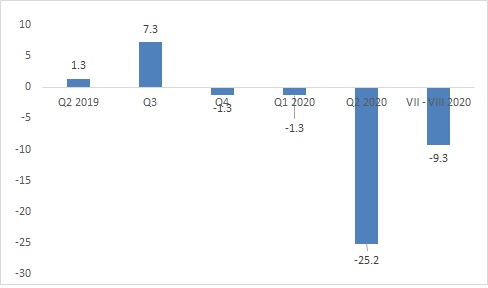
Industrial production: After a sharp decline in the second quarter of 2020, caused by the closure of the economy and the subsequent decline of aggregate supply and demand, industrial production still recorded a negative trend. Namely, in the first two months of the third quarter of 2020, the industrial production declined by 9.3%, although the intensity of the decline is lower than in the previous quarter. This result is due to the partial recovery of the economy and the easing of restrictive measures, as well as the introduced fiscal-monetary measures by the Government and the Central Bank intended for economic recovery. However, the same did not contribute to a full return to normal industrial production. The analysis by individual industries shows a decline in almost all branches except the pharmaceutical facilities, chemical industry, ore production, and the production of computers, electronic and optical products. These industries have proved more resilient to shocks, primarily due to the nature of their sector, and, most importantly, due to the increased demand for their products due to the specific circumstances created by the pandemic, i.e. increased consumption of disinfectants and increased demand for electronic equipment and computers that are necessary due to changes in the way companies, public institutions and health (and education) sector work.

Industrial production data indicate that industry will make a negative contribution to GDP growth in the third quarter of 2020.

Graph 1: Industrial production, annual growth rate
Source: State Statistical Office

Trade:

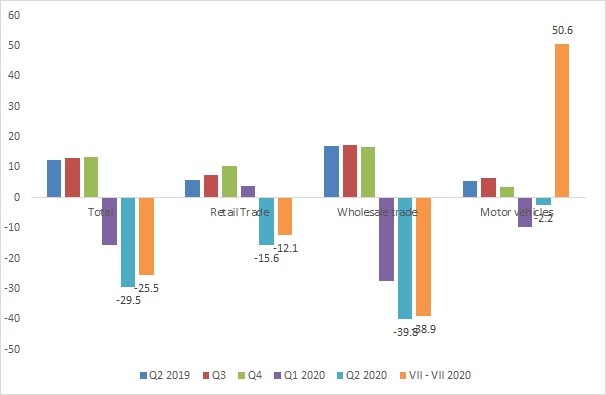
Data on trade developments continue the negative trend according to the initial data for the third quarter of 2020. As can be seen from Chart 2, we see a subsequent decline in trade volume over the entire period from 2020. Total trade decreased by 25.5% in the period July-August 2020, with the decline due to two of the three components, but mostly wholesale, identical to the second quarter of 2020. We only notice a positive trend in the trade of motor vehicles, which is partly due to a larger purchase order of vehicles for public transport in Skopje. Such data indicate that the recovery from the corona crisis will not occur in the short term as we expected at the beginning of the year, i.e. we expect that trade will have a high negative contribution to GDP decline.

Graph 2: Trade, annual growth rates
Source: State Statistical Office

Construction:

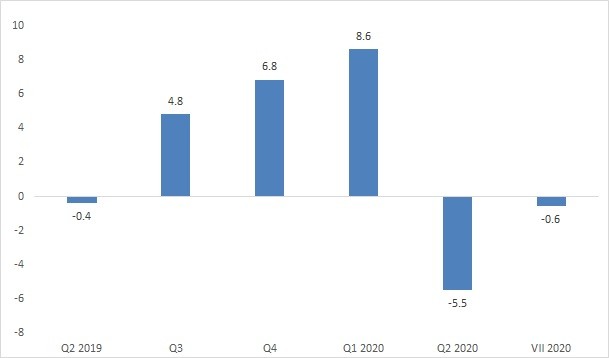
The completed construction works in July 2020 registered a modest decline of 0.6% compared to July 2019. Such developments are more favorable than the data for the previous quarter when we saw a strong negative decline in this sector. Additionally, the capital expenditures in the Budget of the Republic of Macedonia registered a solid growth of about 60%. Taking these indicators into account, as well as the fact that the summer period is the most favorable for the completion of contracted construction works and capital investments, we expect construction to have a positive contribution to GDP growth in the third quarter of 2020.

Graph 3: Completed construction works, annual growth rates
Source: State Statistical Office

Tourism:

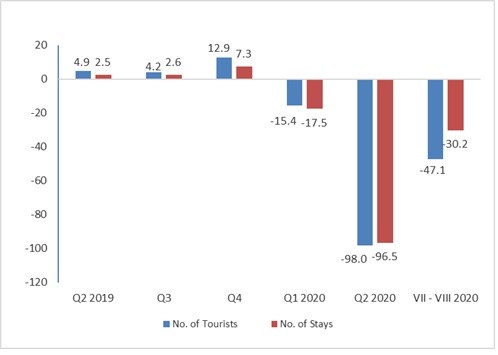
As can be seen from Chart 4, tourism in the period July-August 2020 registered lower negative growth rates, but still the situation is still alarming in this sector compared to the same period in 2019. Tourism in the third quarter of 2020 has big issues as a result of restrictive measures from the past period and bans on entry / exit of foreign tourists. Taking into account the data from July-August 2020, and the limited domestic offer of guests, the indications for this sector are with a strong negative growth rate despite the implemented assistance measures. With this in mind, we expect a strong negative contribution to GDP from the Tourism sector.

Graph 4: Tourism, annual growth rates
Source: State Statistical Office

Expenditure side:

Foreign trade:

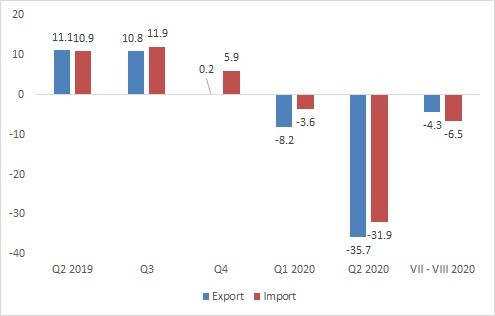
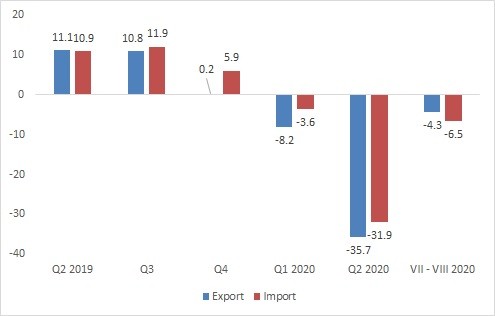
Exports of goods in July and August of 2020 decreased by 4.3%, while imports of goods had a bigger drop of 6.5%. This is the third consecutive quarterly decline in trade indicators, albeit with lower intensity. The data are also in line with the indicators of our largest trading partners from the EU, where international trade indicators still have a negative growth rate. However, given that imports show a higher decline than exports, we expect the contribution of net exports to be moderately positive.

Graph 5: Foreign trade, growth rates
Source: State Statistical Office

Private consumption:

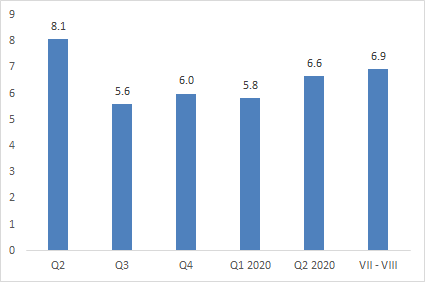
And in the third quarter of 2020, the banking sector is proving to be resistant to the biggest health and economic crisis that Macedonia (and the world) is experiencing in the last 30 years. According to the data from the National Bank, lending to the private sector in July and August 2020 continued to grow with a solid 6.9% on an annual basis. Deposits also showed solid growth, while non-performing loans did not change significantly. However, the great uncertainty from the health-economic crisis indicates the great restraint of the citizens for consumption and as a result we expect a moderate negative contribution of the private consumption to the GDP for the third quarter of 2020.

Graph 6: Loans to the private sector, growth rates
Source: National Bank of Republic of North Macedonia

Gross Investments:

The developments in the gross investments in the period July-August are relatively better compared to the other movements in the real sector. Long-term corporate loans increased by 13%, capital expenditures in the Macedonian budget increased by 60%, while imports of machinery and transport equipment dropped modestly by 1%. Such data indicate a positive contribution to gross investment in GDP.
Quarterly economic monitor − projections Q2 2022

Macedonia 2025 forecasts: GDP growth in Q 2 2022 will be between 1.5 % and 3.5 %

According to the latest high-frequency indicators and the data available so far, we forecast a positive but relatively low growth of the Gross Domestic Product, i.e. a growth of 1.5% to 3.5%. The main reason for the predicted relatively low economic growth is the war in Ukraine, the high rise in prices at the world level, as well as the disruption of supply chains in the world.

The projection is result of the following economic developments in the second quarter of 2022:

Production side:

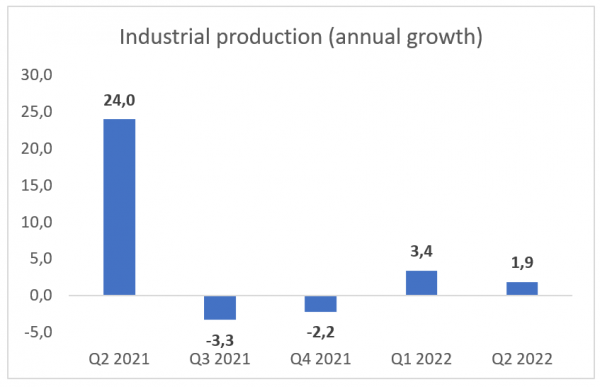
Industrial production: In the second quarter of 2022, industrial production recorded a modest increase of 2.9%, which is actually within expectations considering the global challenges faced by the world. Namely, the main reason for the low growth of the industry in the analyzed period is actually the deterioration of the global supply chains, but this time caused in a larger part by the war between Russia and Ukraine and in a smaller part by the prolonged health crisis, especially on the territory of the People’s Republic of China. The analyzed data by individual industrial branches for the second quarter show that the low growth of industrial production is due to the greater part of the increased production in the “Supply of electricity, gas, steam and air conditioning” sector, whereas the processing industry recorded a negative growth rate. Therefore, the decline is mostly due to the traditional sectors – especially the production of metals and food, whereas the production in the automotive industry, that is, among the exporting companies located in the technological development zones, recorded a stable single-digit growth.

Graph No. 1: Industrial production, annual rates of change

Source: State Statistical Office

Industrial production data indicate that industry will have a positive, but low contribution to GDP growth in the second quarter of 2022.

Trade:

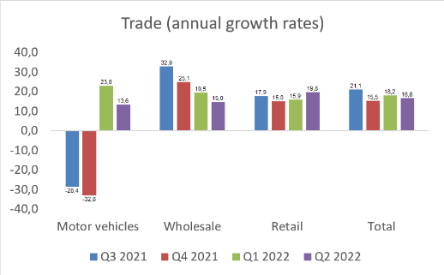
As it can be seen in graph 2, a solid increase in the volume of trade is observed in the second quarter of 2022. Namely, the total trade recorded a growth of 13.6%, whereby the growth is due to the positive developments in all three components, and especially as a result of the increase in retail trade. However, this represents a slight slowdown in growth compared to the previous quarter, which is again expected taking into account global developments, especially the war in Ukraine, as well as the global food shortage. The turnover of motor vehicles for the second consecutive quarter recorded a solid double-digit increase, which points to the strengthening of the purchasing power of Macedonian citizens. However, the turnover of motor vehicles is still at a significantly lower level compared to the sale of motor vehicles before the health crisis, i.e. in 2019.

Such trade data indicate that this sector will have a positive contribution to GDP growth, but lower compared to the previous quarter.

Graph No.2: Trade, annual rates of change

Source: State Statistical Office

Construction:

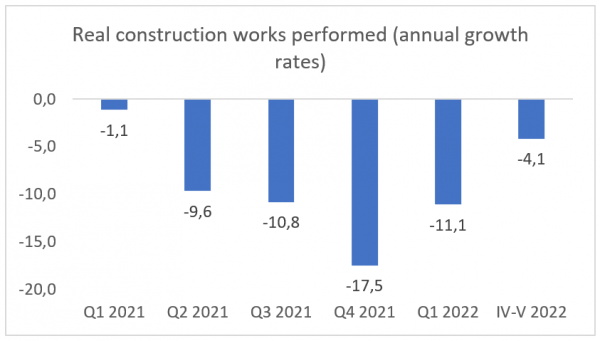
Construction works performed in the period April-May 2022 recorded a real decline of 4.6% compared to the same period of the previous year. Such developments are unfavorable and represent the sixth consecutive quarter of decline in construction in the Republic of North Macedonia. Thus, the decline is significant in low-rise construction, whereas high-rise construction shows an increase. The stagnation in the construction of the Kichevo-Ohrid highway, but also other capital projects, including the Shtip-Kochani road, as well as the weaker implementation of other capital projects throughout the country financed by foreign loans, is the main reason for the deterioration of the figures in the construction sector. On the other hand, in the second quarter of 2022, capital expenditures in the Budget of the Republic of Macedonia recorded a high growth. Such data indicate that construction will have a negative contribution to GDP growth in the second quarter of 2022.

Graph No.3: Construction works performed, annual rates of change

Source: State Statistical Office

Tourism:

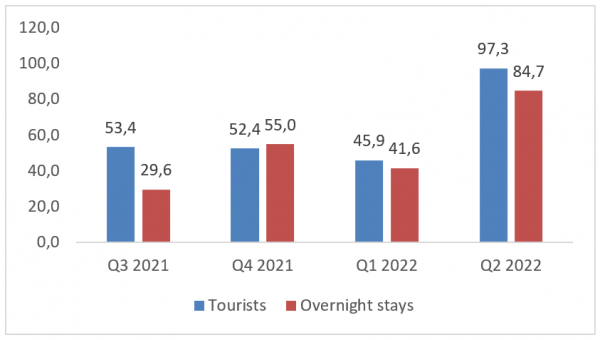
As it can be seen in graph 4, tourism in the second quarter of 2022 recorded a significant improvement in both the number of tourists and overnight stays. The data shows that the improvement is solid and above expectations considering the war in Ukraine, as well as the risks present with the disruption of supply chains. However, the comparison of the nominal numbers of tourists and the number of overnight stays compared to 2019 confirms that it will take more time for this sector as one of the most affected in the Macedonian economy to return to the pre-crisis levels caused by the Covid-19 pandemic and the war in Ukraine.

Taking into account all these data, this sector is expected to have a positive contribution to GDP growth for Q 2 2022.

Graph No. 4: Basic data on tourism, annual rates of change

Source: State Statistical Office

Expenditure side:

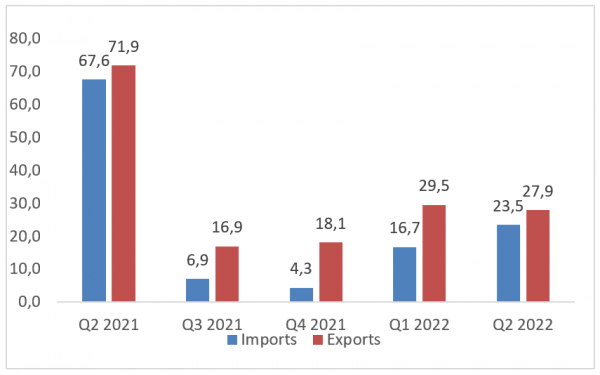
Foreign trade exchange: Exports of goods in the second quarter of 2022 recorded a growth of 23.5% compared to the same period last year, whereas imports of goods recorded a greater increase of 27.9%. However, the rise in prices on world markets is the main reason for the high growth of exports and imports. The main contribution to the realizations of exports in this period is the growth of the traditional sectors (iron and steel), the export of energy and food, which is mostly due to the upward developments of the stock exchange prices of these primary products on an annual basis, as well as the growth of exports of the automotive industry.

In terms of imports, energy imports have the highest contribution to growth (under conditions of higher energy prices and simultaneously higher imported quantities). The import of iron and steel, the import of food and consumer goods operated in the same direction. A positive contribution to the growth was also recorded by the raw material import of part of the production facilities in foreign ownership.

Taking into account the growth of exports, but also the higher growth of imports, we expect the contribution of net exports to be negative for Q 2 2022.

Graph No.5: Foreign trade exchange, annual rates of change

Source: State Statistical Office

Personal consumption:

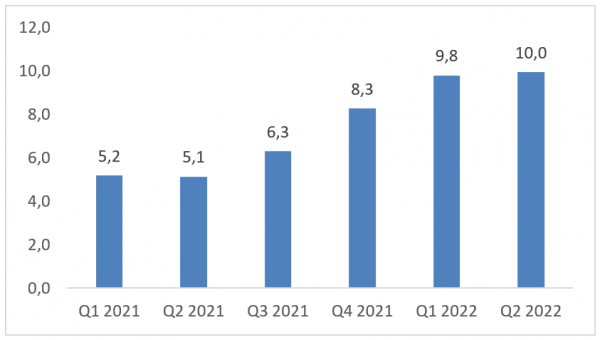
Graph 6 shows the changes as of the second quarter of 2022 in the credit activity of the financial sector in the Republic of Macedonia. The intensity of lending shows a solid growth in the second quarter of 2022 as well, which is related to the growth of the average salary, as well as the increase in imports. According to the data of the National Bank, lending to the private sector in the analyzed period continued to grow at a rate of 10% on an annual basis, that is, the fifth consecutive quarter with an acceleration of the growth of both long-term and short-term loans. The measures of NBRM to slow down credit growth through an increase in the base interest rate still do not show a significant impact on lending to the private sector.

At the same time, solid growth was recorded in the citizens’ deposits, as well as the revenues in the Budget based on value added tax. This analysis points to a positive contribution of personal consumption to GDP for the second quarter of 2022.

Graph No. 6: Lending to the private sector, annual rates of change

Source: National Bank of the Republic of North Macedonia

Gross investments:

Positive developments in the second quarter of 2022 are also observed in the gross investments. Long-term loans of enterprises recorded a growth of 9%, and capital investments in the state budget also recorded a high growth. Additional imports of machinery and transport equipment recorded solid growth. Such data point to a solid positive contribution of the gross investments in GDP.

IMF – World Economic Outlook.

In July 2022, the IMF published the new updated World Economic Outlook. The International Monetary Fund expects growth to slow down from 6.1% last year to 3.2% in 2022, which is 0.4 percentage points lower than in April projections. Lower growth earlier this year, reduced household purchasing power and restrictive monetary policy led to a downward revision of 1.4 percentage points to US growth. In China, further problems with Covid-19 as well as a deepening real estate crisis led to growth being revised downwards by 1.1 percentage points, with large global spillovers. And in Europe, the decline in economic growth reflects spillovers from the war in Ukraine and monetary policy. Global inflation has been revised due to the food and energy prices, as well as lingering supply-demand imbalances, and is expected to reach 6.6 percent in advanced economies and 9.5 percent in emerging markets. In 2023, restrictive monetary policy is expected to have moderate negative effects on global output. In terms of risks, IMF experts believe that they are downward, that is, the war in Ukraine could lead to a sudden stop of European gas imports from Russia, and inflation could be harder to reduce than expected.